
What Is Allied Health Practice Accreditation in Australia. Why Your Practice Can’t Afford to Ignore It

Published by PracPlus | Accreditation Support for Australian Allied Health Practices and Community Health Services
Introduction: The Question Every Allied Health Practitioner Is Asking
Whether you’re a physiotherapist running a busy suburban clinic, an occupational therapist in private practice, a podiatrist serving a rural community, or a chiropractor building a multidisciplinary team – you’ve probably heard the term practice accreditation more than once recently. And you’ve probably wondered: does this actually apply to me? And if it does, where on earth do I start?
The short answer is yes, it applies to you. And the good news? Starting is simpler than you think – especially with the right support.
This guide will give you a clear, practical understanding of allied health practice accreditation in Australia, what the National Safety and Quality Primary and Community Healthcare Standards (NSQPCHS) require, and how PracPlus helps allied health practices across Australia achieve successful accreditation the first time.
What Is Allied Health Practice Accreditation?
Allied health practice accreditation is the formal process by which an independent accrediting agency assesses your healthcare service against the National Safety and Quality Primary and Community Healthcare Standards (NSQPCHS) – a nationally consistent framework for safety and quality in primary and community healthcare settings across Australia.
Launched in October 2021 by the Australian Commission on Safety and Quality in Health Care, the NSQPCHS were designed to create a consistent benchmark of safe, high-quality care that patients can trust regardless of where they receive treatment – from a metropolitan physiotherapy clinic in Sydney to a rural speech pathology service in regional Queensland.
The Three Standards at the Heart of Accreditation
The NSQPCHS are built around three interconnected standards:
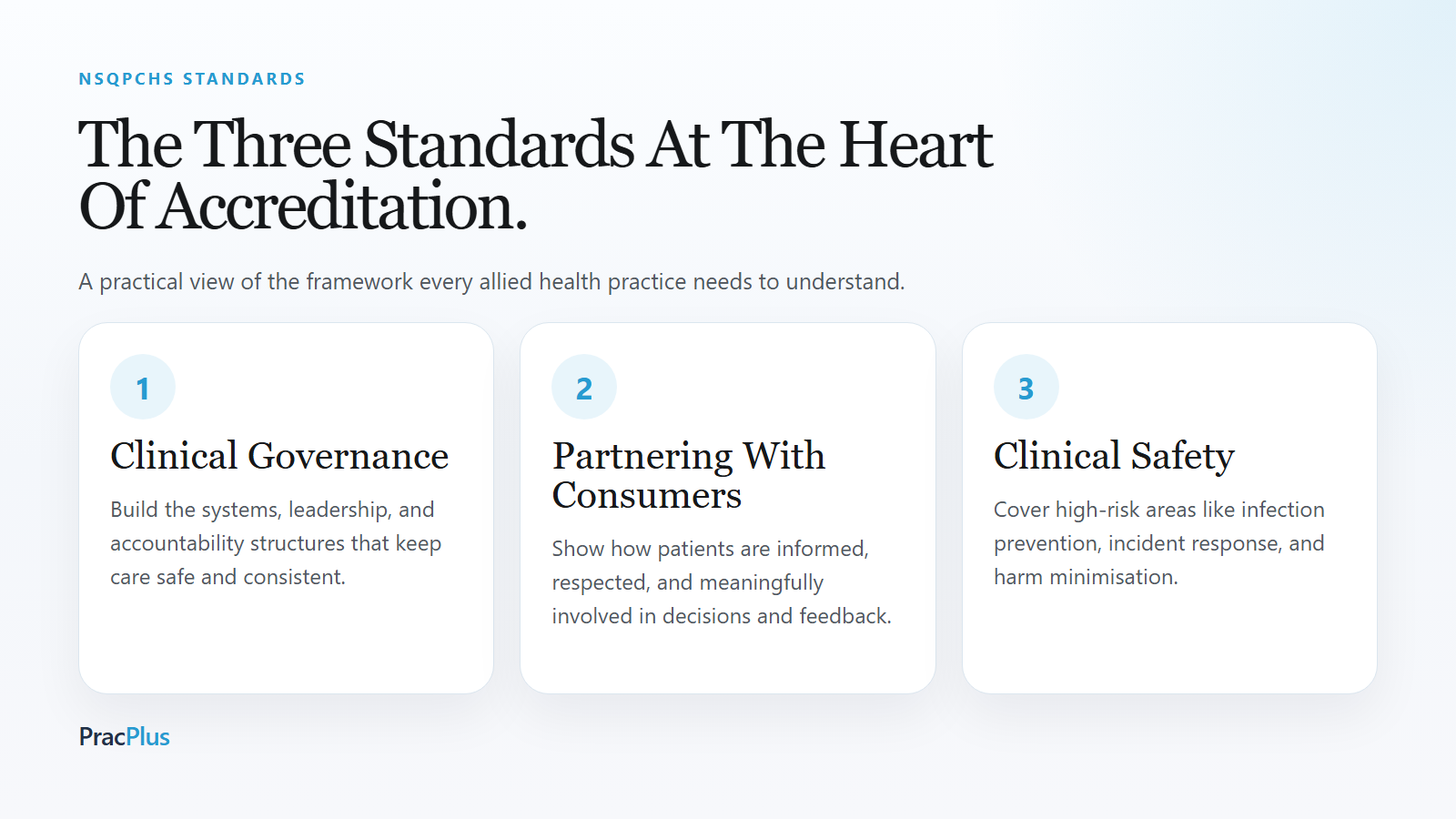
- Clinical Governance Standard
This is the foundation of your accreditation framework. It establishes the systems, leadership structures, and accountability frameworks that ensure your practice delivers safe, high-quality care consistently. Think of it as your practice’s safety net – the framework that catches issues before they become problems. - Partnering with Consumers Standard
This standard is built around the fundamental principle that patients are active partners in their healthcare, not passive recipients of it. It covers everything from how you uphold the Australian Charter of Healthcare Rights to how you implement informed consent, shared decision-making, and consumer feedback systems. The consumer outcome this standard aims to achieve is clear: “I am a partner in my own health care and my opinion is valued in designing and delivering my health care.” - Clinical Safety Standard
This standard addresses the high-risk areas of clinical care that allied health practitioners encounter every day – infection prevention and control, medication safety where applicable, incident management, and minimising patient harm.
These three standards don’t operate in isolation. They work together as an integrated framework where governance and consumer partnership create the foundation that supports clinical safety across your entire practice.
Who Does Allied Health Accreditation Apply To?
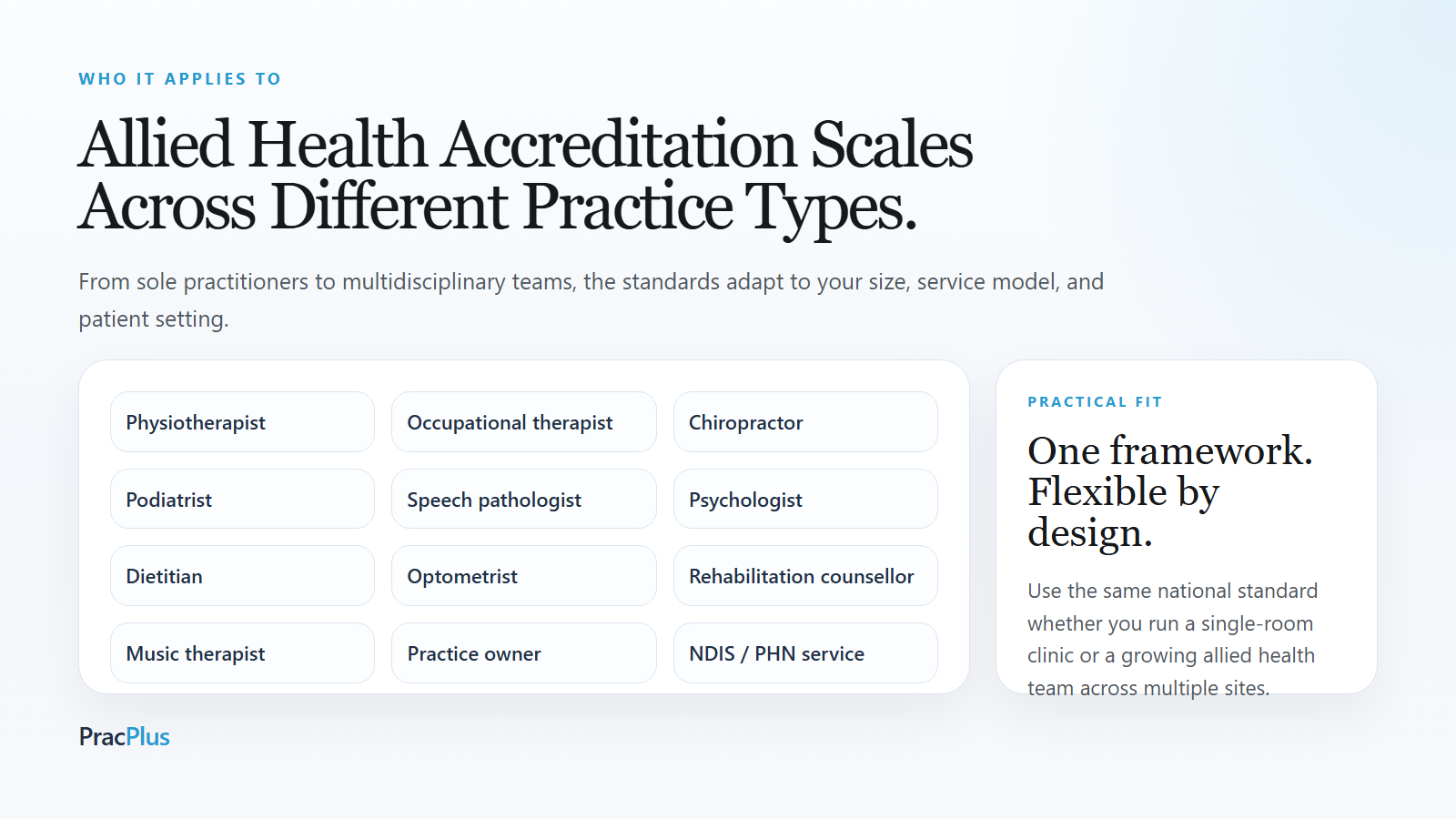
The NSQPCHS apply to all primary and community healthcare organisations in Australia – and the list is broader than many practitioners realise.
If you are any of the following, then accreditation applies to your practice:
- Audiologist
- Physiotherapist
- Chiropractor
- Occupational therapist
- Osteopath
- Psychologist
- Dentist
- Social worker
- Dietitian
- Nutritionist
- Medical imaging / radiation scientist
- Exercise and sports scientist
- Podiatrist
- Orthotist / prosthetist
- Counsellor / psychotherapist
- Rehabilitation counsellor
- Speech pathologist
- Optometrist
- Credentialled Diabetes Educator
- Genetic counsellor
- Orthoptist
- Hand therapist
- Dermal clinician
- Art therapist
- Music therapist
- Myotherapist
- Sonographer
- Pedorthist
- Other allied health profession
- Member organisation staff
- Aboriginal and Torres Strait Islander health worker / practitioner
- Allied Health Practice owner / office administrator
- NDIS and PHN-commissioned allied health services
Critically, the standards are scalable. Whether you are a sole practitioner working from a single treatment room or part of a large multidisciplinary team across multiple sites, the NSQPCHS are designed to be adapted to your specific practice size, patient population, and service complexity. A sole practitioner physiotherapist, for example, fulfils the roles of owner, manager, and clinician simultaneously – and the standards recognise and accommodate this reality.
Is Allied Health Accreditation Mandatory?
This is one of the most frequently asked questions – and the honest answer is nuanced. Accreditation is technically voluntary under the NSQPCHS framework. However, for a rapidly growing number of allied health practices across Australia, it is effectively “voluntary but not optional.”
Here’s why:
Patient Expectations Have Shifted
Today’s healthcare consumers are more informed than ever. They expect transparency, documented quality systems, and evidence that the practitioners they trust with their health have been independently assessed and found to meet national safety standards.
Funders Are Increasingly Requiring It
The NDIS, Primary Health Networks (PHNs), and private health insurers are increasingly favouring – and in some cases requiring – accredited providers as preferred partners. If your practice relies on referrals from these funding bodies, accreditation directly affects your bottom line.
It Reduces Risk – For You and Your Patients
Practices with robust clinical governance frameworks, clear incident management systems, and well-documented policies experience fewer adverse events, manage complaints more effectively, and create safer environments for both patients and staff. Strong systems reduce the stress of managing the unexpected.
It Creates Competitive Advantage
In an increasingly competitive allied health market, accreditation distinguishes your practice. Once accredited, you can confidently communicate to your community: “We have been independently assessed and proven to provide safe, high-quality healthcare.”
It Positions Your Practice for Growth
Whether your goal is practice expansion, attracting high-quality staff, pursuing government or institutional contracts, or eventually selling your practice, accreditation significantly strengthens your position. A well-documented, accredited practice is more attractive in every respect – much like a house with a clean building report or a car with a complete service logbook.
What Do Allied Health Accreditation Assessors Actually Look For?
Understanding what assessors examine is essential to successful preparation.
Accreditation assessors use multiple methods to evaluate your practice, including:
- Document review – policies, procedures, clinical records, training logs, incident registers, and evidence portfolios
- Staff interviews – asking your team to explain how they apply safety and quality principles in practice, not just what your policies say
- Patient interviews – verifying that consumer partnership is genuinely embedded, not just documented
- Observational assessments – watching real clinical practice, including infection control procedures, patient interactions, and consent processes
One of the most common gaps assessors identify is the disconnect between documentation and practice reality. Policies may be written and filed, but staff cannot articulate how they apply them. The Charter of Healthcare Rights may be displayed in the waiting room, but reception staff cannot explain how they uphold patient rights in daily workflows. Consent forms may be signed, but there is no evidence of genuine shared decision-making or patient understanding.
Successful accreditation isn’t about having perfect paperwork. It’s about demonstrating that safety and quality are genuinely embedded in how your practice operates every single day – for every patient, in every encounter.
How Long Does Allied Health Accreditation Take?
The accreditation timeline varies depending on your practice size and starting point, but most practices can expect the following:
- Solo practitioners: 3-4 months preparation if starting from a reasonable baseline
- Small to medium practices: 6-12 months for comprehensive preparation
- Larger or more complex services: 12-18 months for full implementation and evidence building
The formal accreditation process typically involves:
- Phase 1: Preparation (3-12 months) – Gap analysis against the Standards, policy and procedure development, staff training, and evidence collection
- Phase 2: Assessment (2-4 months) – Desktop review (Stage 1) followed by on-site or virtual assessment (Stage 2)
- Phase 3: Decision (1-2 months) – Accreditation awarded for 2-3 years upon successful assessment
- Phase 4: Ongoing Compliance – Annual self-assessments, continuous quality improvement, and preparation for re-accreditation
What Happens After You Achieve Accreditation?
Accreditation is not a finish line – it’s the beginning of your continuous quality improvement journey.
Once accredited, your practice enters an ongoing cycle of compliance, self-assessment, and quality improvement. This includes:
- Annual self-assessments against all three Standards
- Ongoing incident reporting and management
- Regular policy and procedure review cycles
- Continuous performance monitoring using key safety and quality indicators
- Staff training and competency maintenance
- Mid-cycle self-review – typically at the 18-month mark – to verify continued compliance
- Re-accreditation preparation beginning 6-12 months before your accreditation expires
The allied health practices that truly excel are those that view accreditation not as a compliance exercise to be completed and forgotten, but as a framework for continuous improvement that genuinely elevates patient safety and care quality every single day.
How PracPlus Makes Allied Health Practice Accreditation Achievable
We know the NSQPCHS can feel overwhelming – especially when you’re already managing patient care, administration, staffing, and the business demands of running an allied health practice without dedicated compliance staff.
That’s exactly why PracPlus was created.
PracPlus is Australia’s specialist accreditation support service for allied health practices. Our comprehensive online course and consultation services are designed to break the NSQPCHS down into practical, manageable steps – giving you the tools, templates, and expert guidance you need to achieve successful accreditation the first time, without the overwhelm.
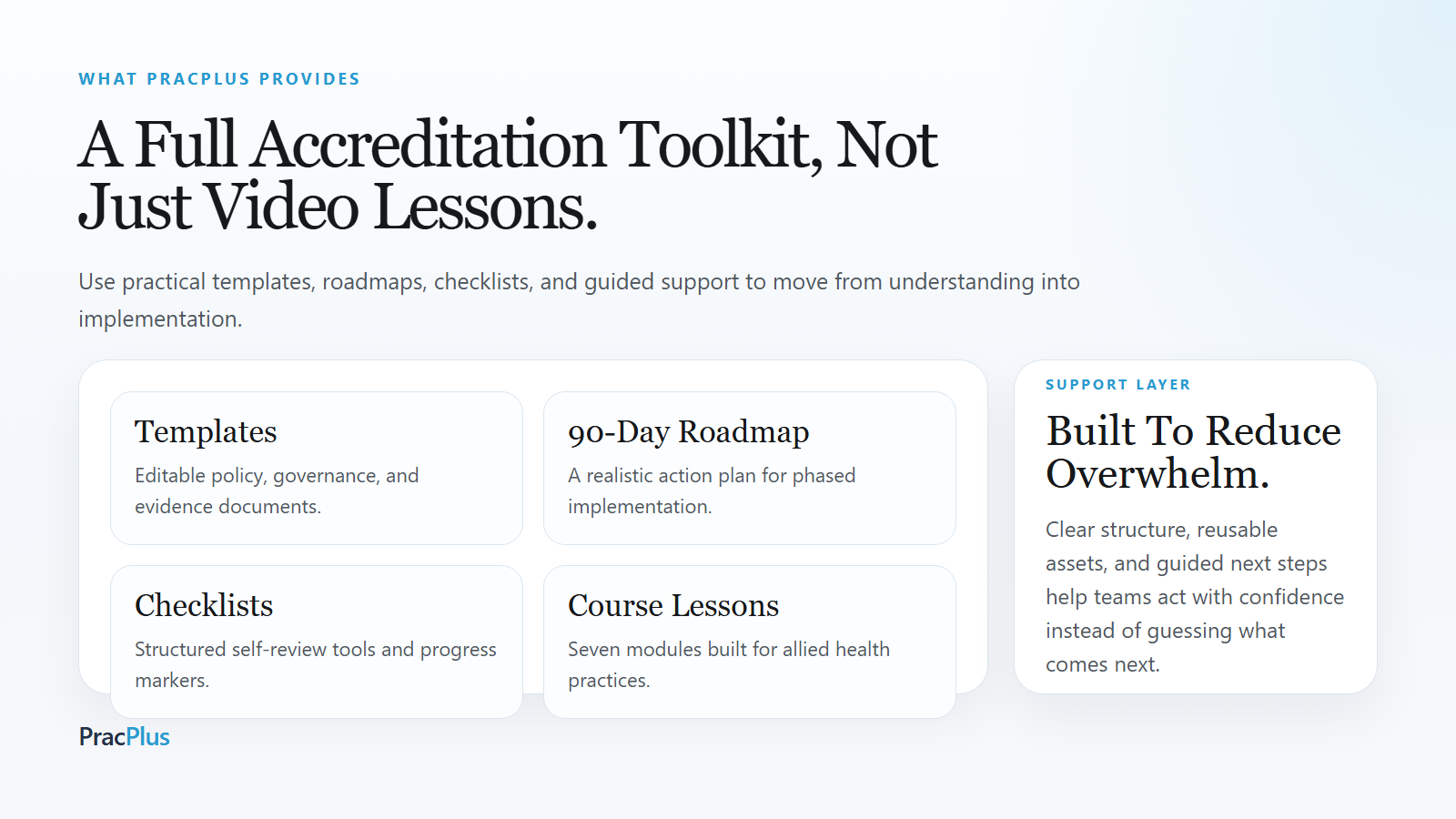
What PracPlus Provides
- Comprehensive Online Course
Seven structured modules covering every aspect of the NSQPCHS – from understanding the Clinical Governance Standard to maintaining accreditation and embedding continuous quality improvement into your daily operations. - Ready-to-Use Templates
A complete clinical governance toolkit including clinical governance framework templates, roles and responsibilities documents, risk and incident registers, complaint management processes, quality improvement project templates, training records, orientation checklists, and essential policy templates across ten key areas – all provided in editable Word and Excel formats you can customise to your specific practice. - 90-Day Implementation Roadmap
A structured, realistic action plan that takes you from foundations to full system integration without trying to do everything at once. - Expert Consultation Services
One-on-one consultation, documentation review, mock assessment preparation, and team training packages designed to get your entire team on the same page – efficiently and effectively. - Mid-Cycle and Re-Accreditation Support
Ongoing guidance, self-assessment checklists, and consultation support to help you maintain your accredited status and prepare confidently for re-accreditation. - CPD Recognition
Time invested in the PracPlus course counts toward your annual Continuing Professional Development requirements for AHPRA registration.
Your First Step Starts Here
Accreditation is achievable for every Australian allied health practice – regardless of size, specialty, or starting point. With the right mindset, practical tools, and expert support, you can build a practice that doesn’t just meet the NSQPCHS standards but genuinely lives them every day.
Visit www.PracPlus.com.au today to:
- Download your free Practice Accreditation Checklist
- Explore the PracPlus online course and module previews
- Learn about our consultation and team training packages
- Book a complimentary discovery call with our accreditation experts
Your patients deserve safe, high-quality care. Your practice deserves the recognition that comes with accreditation. PracPlus is here to make both a reality.
